What the Triple Whale Breach Exposed and What to Do Now
By Will Sibley · Published November 24, 2026 · Last checked November 24, 2026
Triple Whale, the Shopify analytics app, confirmed on November 20, 2026 that an unauthorized party got into some of its internal systems. It says it found the intrusion on October 31, contained it on November 1 and has notified the people affected. Sneak Energy, one of the brands it notified, says its customers' names, email addresses, phone numbers, mailing addresses and lifetime spend were exposed, but not payment details or passwords. If you haven't had a notice from Triple Whale, it says there's no action needed on your Triple Whale account.
By the Numbers is also a Shopify analytics app, so Triple Whale is a competitor of ours. We've kept to what Triple Whale, the affected brands and Shopify have published, linked every source, and marked anything that hasn't been confirmed.
What to do today, in rough priority order:
- Check whether Triple Whale notified you. Search every inbox tied to a Triple Whale login, spam folders included, for email from Triple Whale since November 3.
- If it did, warn your customers about scam messages that quote their name, home address or an order number, starting with your highest spenders.
- Check whether you have to report the breach. In the UK, a notifiable breach has to reach the ICO within 72 hours of you becoming aware of it.
- Review every app that can read your customer data, and uninstall the ones you don't use.
Each step is covered in more detail below.
What happened, in order
Triple Whale hasn't said how the attackers got in, what was taken or how many stores were affected. This is the sequence pieced together from its statement, two brands' customer notices and the Shopify App Store.
| Date (2026) | What happened | Source |
|---|---|---|
| October 30 | Unauthorized access to systems holding Sneak Energy's store data begins | Sneak Energy's notice, via Geek Native |
| October 31 | Triple Whale identifies the incident | Triple Whale on X |
| November 1 | Triple Whale says the incident is contained | Triple Whale on X |
| November 2 | Triple Whale's listing comes off the Shopify App Store, with no reason given | Revenue Shield's delisting tracker |
| November 3 | Triple Whale tells Sneak Energy | Geek Native |
| November 6 and 7 | Who Gives A Crap hears from an unnamed US marketing software provider about a breach on the same dates, and emails its customers | Digital Citizen |
| November 11 | A hacker forum listing claims 12.6 million customer records tied to Triple Whale and Tarte Cosmetics | Kalir Pulse |
| November 12 | Sneak Energy emails its customers | Geek Native |
| November 20 | Triple Whale posts its statement on X | Triple Whale on X |
| November 24 | Triple Whale's App Store page still says the app isn't available | Our own check (screenshot below, taken November 23) |
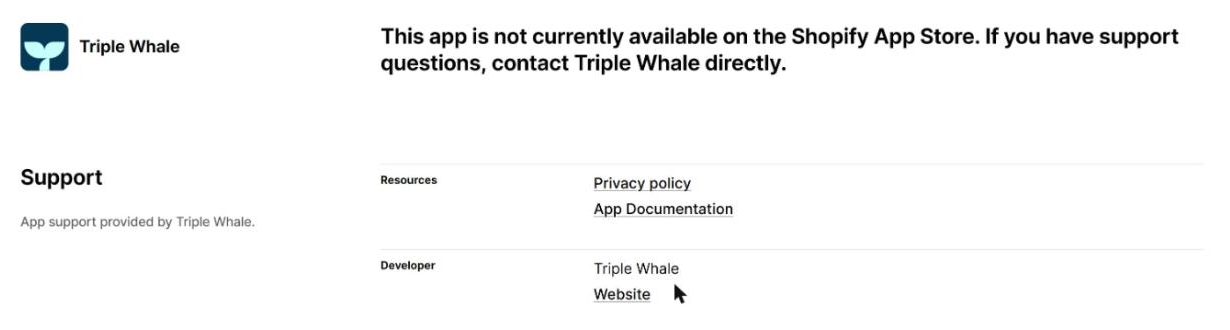
Triple Whale's Shopify App Store page when we checked it on November 23, 2026.
Ecomm Cowboy's 12-minute rundown from November 20 walks through the same timeline. Its title repeats the attacker's store count, which hasn't been confirmed.
What was exposed, and what wasn't
Sneak Energy, a UK drinks brand, named Triple Whale in the notice it emailed customers on November 12. It lists these as exposed:
- first and last names
- email addresses
- phone numbers
- mailing addresses
- the total each customer has spent with the brand
The notice says there was no access to payment details, order details or passwords, and that Sneak Energy doesn't yet know whether the data was copied or downloaded.
Who Gives A Crap, the toilet paper brand, told customers in Australia, the UK and the US about a breach at an unnamed US marketing software provider. Its dates match Sneak Energy's (access from October 30, found on October 31, secured on November 1), and so does the list of exposed data. It hasn't named the provider, though, so we can't confirm it's the same incident.
The spend total is the field we'd worry about most. A list that pairs each customer's name and home address with how much they've spent lets a scammer pick out a store's best customers. They can then write with details that look genuine, such as a refund text that quotes the customer's real address.
What's claimed but not confirmed
Three numbers are going around that nobody has confirmed.
- A BreachForums listing found on November 11 claims data tied to Triple Whale and tartecosmetics.com, made up of 218,783 accounts, 189,152 password hashes and 12.6 million customer records (Kalir Pulse). Triple Whale hasn't confirmed it, and we couldn't find any statement from Tarte Cosmetics.
- A post from the security account Rivanorth says the same dump holds Shopify access tokens for 20,510 stores (Rivanorth on X). That figure comes from the attacker's listing.
- Sneak Energy's notice says it's one of more than 65,000 companies affected. That figure comes from Sneak Energy, not Triple Whale, and it matches the 65,000+ brands that Triple Whale's own partner page says use its software (Triple Whale). It may describe Triple Whale's whole customer base rather than a count of affected stores.
Were you affected?
Triple Whale says it notified everyone affected, and that customers who didn't receive a notice have no action to take on their Triple Whale accounts. Sneak Energy got its notice on November 3, so start your search from that date and include every member of your team with a Triple Whale login.
If you can't find a notice and want to be sure, ask Triple Whale. Its App Store page tells merchants to contact Triple Whale directly with support questions.
What to do now
If Triple Whale notified you, or you're still not sure, work through these in order.
- Tell your customers if Triple Whale notified you. Say plainly what was exposed and what wasn't, and how to spot a scam. Sneak Energy's notice is a good model. It asks customers to ignore unexpected emails, calls or texts that mention the brand, Triple Whale, order numbers or home addresses. It also tells them to type the brand's web address into their browser rather than click a link, and to send questions to one address with the subject line "Data incident".
- Start with your highest spenders. Because spend totals were exposed, the customers who've spent the most are the easiest to target. Build a Shopify customer segment of people whose amount spent is above a level you choose (our guide to customer segmentation in Shopify shows how), and contact them first.
- Check whether you have to report it. Under UK GDPR, a notifiable breach has to be reported to the ICO within 72 hours of becoming aware of it (ICO), and a business is usually treated as aware once its supplier tells it (ICAEW). The rules outside the UK differ, so check with your legal adviser. We're not lawyers, and this isn't legal advice.
- Review every app that can read your customer data. In Shopify admin, go to Settings > Apps. Shopify now shows each app's security setup there, including whether it uses expiring tokens and an IP allowlist, and since November 20 it has flagged public apps without an allowlist (Shopify). To see what an app can read, open its App Store listing and find the Data access section. The panel for our own app is below. Select See details to see exactly which fields an app can read. For our app, "Sensitive data" covers customer names, email addresses, phone numbers and physical addresses.
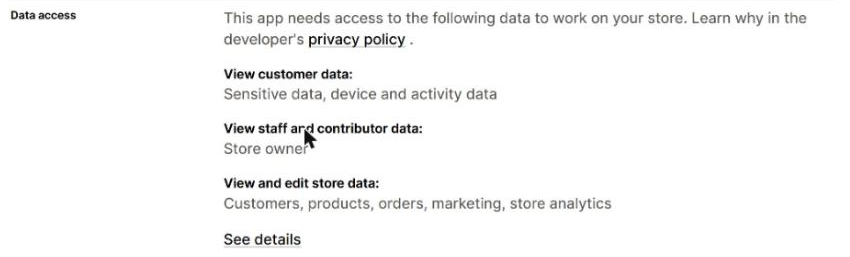
The Data access panel on our own App Store listing, captured November 23, 2026. Every listing has one.
-
Uninstall the apps you don't use. Shopify says a token that never expires stays valid until the store uninstalls the app or the developer revokes its secret (Shopify). Forty-eight hours after you uninstall, Shopify also sends the app a request to erase your store's data (Shopify).
-
If you still use Triple Whale, get answers to these questions before Black Friday on November 27:
- Was our store's data in scope, and which fields?
- Was our store's access token taken, and has it been replaced?
- Were our team's logins or password hashes involved, and should we reset them?
- When will the app be back on the Shopify App Store?
If you gave Triple Whale an API key for another tool, create a new key in that tool and delete the old one.
Why an analytics app holds this data
We build a Shopify analytics app, so this is the part we can explain from the inside. Lifetime value, repeat purchase rate and cohort retention all need every order and every customer record, not a sample. Apps like ours keep their own copy of that data so reports load quickly instead of asking Shopify for years of orders every time. A breach of an analytics app exposes that copy.
It doesn't hand over your Shopify admin login, but a stolen access token can be just as useful to an attacker. When you install an app, Shopify gives it a token for your store, limited to the permissions you approved. Older public apps can still hold tokens that never expire, so a leaked one keeps working until the store uninstalls the app or the developer revokes its secret (Shopify).
Shopify is closing both gaps. Every public app had to set an IP allowlist by November 20, which Shopify says stops a leaked token from working anywhere but the app's own servers (Shopify). Public apps also have to move to expiring tokens by January 2027 (Shopify). Neither change undoes a breach from late October, but both make a token stolen in the future much less useful.
Frequently asked questions
Is Triple Whale safe to use now?
We compete with Triple Whale, so we're not the right people to judge that. The four questions under What to do now are the ones we'd want answered about any app that holds our customers' data, ours included.
Was Shopify hacked?
Nothing published so far says Shopify's own systems were breached. Triple Whale's statement describes unauthorized access to its own internal systems.
Why isn't Triple Whale on the Shopify App Store?
A public delisting tracker shows its listing coming down on November 2, and the page still said the app wasn't available when we checked on November 24. Neither Shopify nor Triple Whale has said why.
Is this connected to October's checkout hijack?
No public source links them. In that separate incident, three app makers (Logbase, Swym and HulkApps) confirmed that unauthorized code reached storefronts through their apps (Revenue Shield). Triple Whale's incident is described as access to its internal systems, and none of the sources we read ties its delisting to the hijack.
Should I uninstall Triple Whale?
If you no longer use it, yes, since uninstalling ends its access to your store. If you still use it, get answers to the four questions under What to do now first. Uninstalling stops the app reading new data from your store, but it doesn't recall data that was already taken.
Do I need to tell my customers?
That depends on where you and your customers are, so start with the reporting step under What to do now. Sneak Energy and Who Gives A Crap both emailed their customers, and their notices are a useful model for what to say.
How we checked this
We read Triple Whale's statement on X, Sneak Energy's notice as published by Geek Native, the reporting on Who Gives A Crap's notice, Shopify's developer changelog and documentation, and the other sources below. We checked Triple Whale's App Store page ourselves on November 23 and again on November 24, 2026, when its X account had posted nothing new since its November 20 statement. We used Reddit threads only to find leads, never as the source of a fact. We didn't download or open the leaked data, and you shouldn't either, because it's stolen personal information.
We'll update this page when Triple Whale or the affected brands publish more.
This page was first published on November 24, 2026.
Sources
- Triple Whale's statement on X, November 20, 2026
- Sneak Energy's customer notice, reported by Geek Native, November 12, 2026
- Who Gives A Crap's notice, reported by Digital Citizen and The Register
- Shopifreaks on Triple Whale's confirmation, November 22, 2026
- Kalir Pulse on the BreachForums listing, detected November 11, 2026
- Rivanorth on X
- Revenue Shield's list of delisted Shopify apps
- Triple Whale's technology partner page
- Shopify: IP allowlists are now required for public apps, App security updates, Access modes, Use expiring offline access tokens, Privacy law compliance
- ICO: report a personal data breach
- ICAEW: personal data breaches
About the author
Will Sibley works on growth at By the Numbers, where he runs merchant onboarding and builds growth assessments from stores' Shopify data. He was previously Senior SEO Manager at The Telegraph.