Are your Shopify discounts too deep?

Before repeating a sale, compare Shopify store discount depth with similar stores and check whether your margin supports the offer. Stores Like Yours, a beta report in By the Numbers, now gives a clearer Average Discount Depth reading. Use it to question the next promotion, then test a change against your own results.
A busy sale can leave you with a harder question: did you need to give that much away? The comparison gives you context for that decision. It cannot tell you which offer will be most profitable for your store.
Start with what the discount needs to achieve
Choose the job of the offer before deciding how deep it should be. Clearing old stock, attracting a new buyer, and encouraging another purchase call for different choices.
For clearance, you may accept less profit to release cash tied up in stock. For a welcome offer, you need to consider the cost of bringing the customer in. For a repeat purchase, ask whether a reminder or early access would be worth testing before another price reduction.
Write that goal beside the offer you are considering. Name the products and customers it is meant to reach. A promotion aimed at old stock gives you little reason to cut the price of a bestseller that still sells well.
Check what you mean by a discount, too. Shopify's guide to sale prices distinguishes a compare-at price from a discount. A crossed-out storefront price and a discount applied at checkout are different things. Keep that distinction in mind when discussing an offer with your team.
Read discount depth before changing the offer
Start with Average Discount Depth in Stores Like Yours. The recent change makes that reading match the familiar meaning of a percentage off. It gives you a clearer starting point when you ask how your discounting compares.
Open Stores Like Yours under Benchmarks. For navigation and help reading the comparison, use the Stores Like Yours help guide. The scorecard below shows where your store's figures sit beside the comparison.
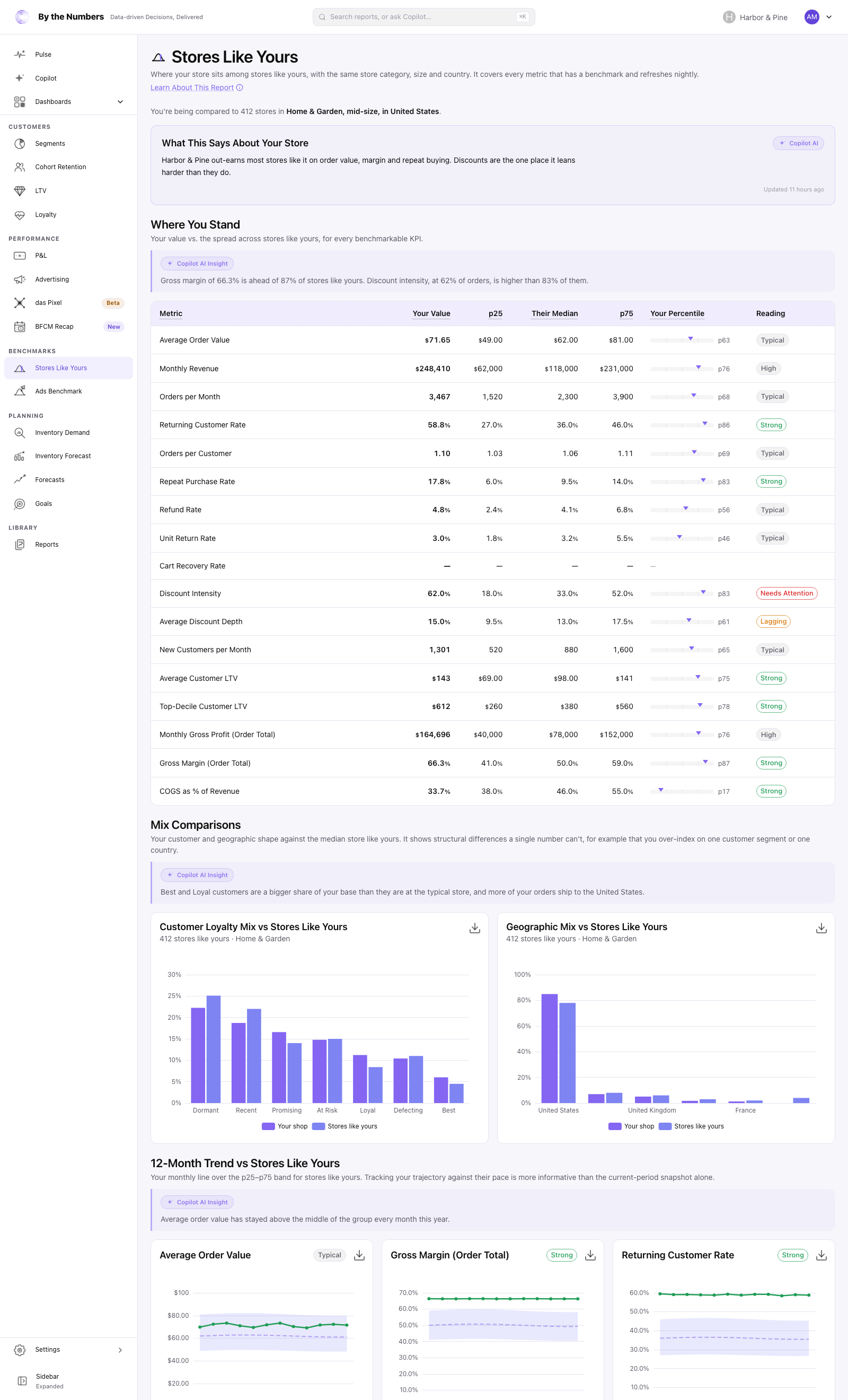
If your discount depth is higher, investigate before repeating the same offer. Perhaps you were clearing a seasonal collection. Perhaps the offer reached customers who would have bought at full price. Those explanations lead to different next steps, and the comparison alone cannot choose between them.
A lower reading also needs context. It could leave room to test an offer, but it does not tell you that a deeper discount would pay. Your product costs, customer demand, and reason for running the promotion still matter.
Keep margin beside the discount question. The broader ecommerce KPI guide explains why sales growth needs to be read alongside the money the store keeps.
Check customer behavior alongside the discount
Read customer behavior as another clue before deciding that a bigger offer is needed. The same update improves the Orders per Customer and loyalty mix comparisons in Stores Like Yours.
Use those comparisons to frame a question about repeat buying. If discounts are deep and repeat buying is a concern, review what happens after the first purchase. The next useful check might be product satisfaction, a reminder, or whether buyers had a reason to return.
These comparisons do not show that discounts caused a loyalty pattern. A store can have a strong reason to run a clearance sale while also needing better follow-up for recent buyers. Treat those as separate decisions until you have evidence connecting them.
For broader context, the ecommerce benchmarks guide explains how to use comparisons without treating them as targets. Another store's typical result is a prompt to investigate your own business.
Choose one small test
Turn the comparison into a limited test with a clear end. Choose an audience or product group where you can explain why the offer should help.
If you suspect the offer is too broad, try narrowing the eligible collection. If you suspect customers need a reason to return, consider a relevant reminder before offering more money off. A bundle or gift can also be worth testing, provided its cost fits the margin you need.
Before starting, check whether another live offer overlaps with the test. Set the end date and decide what would make you stop it. Keep a record of the offer, its audience, and the result you want to improve.
Judge the test by profit as well as sales. Check what remains after the discount, product costs, shipping, and paid acquisition costs. A larger basket can still leave less money for the store. The average order value guide gives that basket-size question more context.
Use ecommerce reporting to support the review, then record what you would keep or change. The useful outcome is a reasoned next offer: who it serves, what it costs, and what would justify repeating it.
Keep reading
If you want the full picture on ecommerce metrics and KPIs, start with the ecommerce metrics that predict growth.
Related reading: Average Order Value by Industry, Ecommerce Benchmarks: Data From Shopify Stores and How to Build an Ecommerce KPI Dashboard for Shopify.
By the Numbers builds this into the dashboard. See Shopify ecommerce reporting.
See what is working in your Shopify store
By the Numbers turns your store data into reports, segments, and forecasts.
- AI-powered analytics
- Customer segmentation
- Predictive forecasting
- One-click Shopify install