Using Machine Learning to Forecast Sales on Shopify
Shopify Sales Forecasting That's Done for You Quickly
Being able to do Shopify Sales Forecasting properly takes time.
You would need to:
- Gather your data
- Put your data on a data analytics platform
- Find out how to properly forecast your data
- Forecast your data
- Make sure your forecast is accurate (this is the annoying part)
- Double check that your forecast is accurate (this is also annoying)
- Make a decision on which direction to take your store that can cost you thousands.
If you’re going to make a decision for your business, then it makes sense to ensure your forecasting and other data analysis is done properly right? There’s no point of even forecasting your data if you know from the beginning that it’s not going to be accurate.
That’s the issue, store owners constantly think they can do it on their own and expect no errors. Then they make a decision for their store that drains way too much money.
Luckily, there’s a much easier way. Also, a much faster way. Also, a way that allows you to set a pace for yourself to make sure you meet those forecasting goals.
What is Forecasting?
Forecasting in the simplest terms predicts something in the future using past data.
So for Shopify sales forecasting, it’s using your store’s past data to predict your future store’s data.
When it comes to doing a Shopify sales forecast properly, you want to use a platform that accounts for everything. This means accounting for holiday seasons, or parts of the year where business is slow.
This approach allows us to accurately predict sales even if there are significant seasonal variations, with just a few seasons of historical data. Our model can handle missing data, shifts in trends, and outliers with ease, ensuring reliable and robust forecasts.
What the model actually reads
A useful forecast is more than a curve fit. The model needs every signal that drives your revenue. Here is what By the Numbers reads from your store:
- Company trends. Long-run growth or decline in revenue, orders, and AOV.
- Seasonality at three resolutions. Yearly (your peak quarter), weekly (the days that consistently outperform), daily (the hours when your traffic converts).
- Holidays. Black Friday, Cyber Monday, regional holidays, and the days around them.
- Promos and one-off events. Campaign launches, product drops, sales windows.
Missing data is fine. The model fills gaps using the patterns it already learned from the rest of the store, so a few quiet months or a paused channel will not throw the forecast off.
Why You Should Care About Shopify Sales Forecasting
One morning you wake up. You took yesterday off from managing your store and you had an amazing night.
By the time you come home from your evening out, you pass out and fall asleep. The next morning you find that your store had a bunch of traffic! It’s almost too good to be true.
Because it is.
You thought it was a bunch of notifications that was telling you about the new sales you’ve made. Instead it’s notifications showing that customers were all asking the same thing, “When will this product be back in stock?”
You missed out on an opportunity. A big one. Had you forecasted your sales data, you would’ve seen that this product is popular around this time of year. But because you didn’t you didn’t restock an important item and missed out on thousands of dollars
Shopify Sales Forecasting
- Lets You Anticipate Demand: No more guesswork. You can predict when customers will come and buy products
- Makes you Plan Campaigns Properly: The ROI of a campaign is the most important part of advertising. With Shopify Sales Forecasting, you increase the ROI by a huge amount
- Manage Cash Flow: One of the most important aspects of your store. Cash allows you to keep your business afloat. But you can float a lot easier if you know where to invest your cash at what time. A sales forecast gives you that
- Lets you Study Each Customer Group: Customer Segmentation is key. Understanding each group allows you to personalize your approach to each customer
Accessing Your Shopify Sales Forecast
If you want to access a detailed sales forecast, then it’s best to choose a data analytics platform that specializes in helping Shopify Stores.
Here’s one from By the Numbers. Click “Forecast AI & Goals” on the top left.
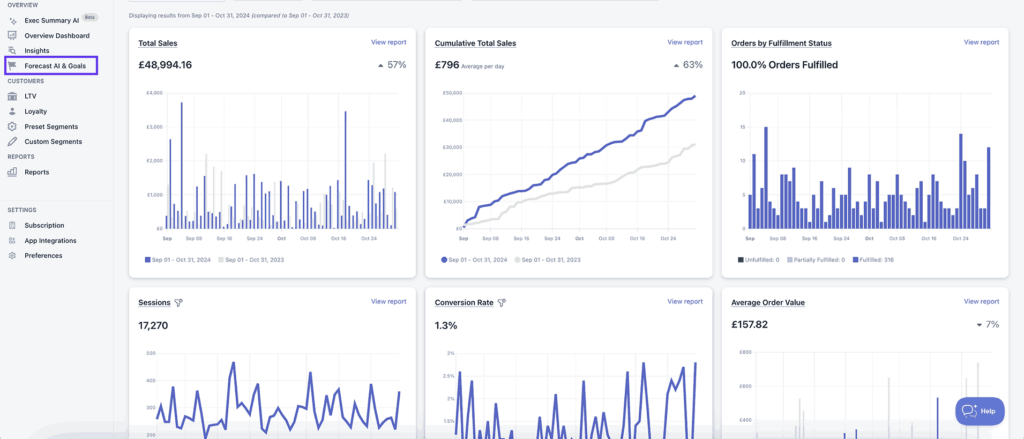
You can access your sales forecast in two locations: the Insights page and the Goals page. Both can be accessed by selecting them from the left navigation menu.
At the top left of the Insights page, you will see the forecasted amount for the current period (this image is from Jan 2025):
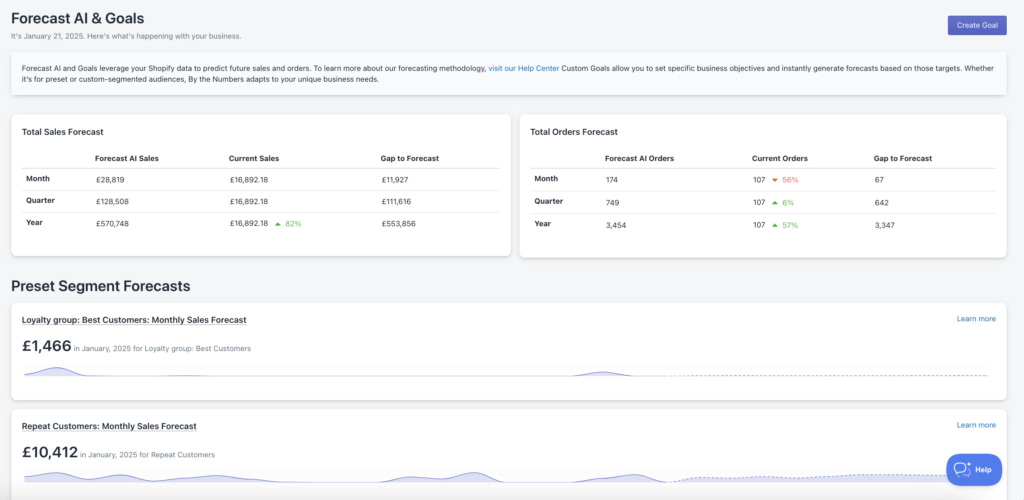
A good data analytics platform should give you the full detailed picture from a monthly, quarterly and yearly perspective. With machine learning, there is no guesswork and the accuracy is much better. Enjoy features such as:
- Sales Forecast
- Orders Forecast
- Sales Forecast based on Customer Segments
You can also set goals that keep pushing you to hit your targets
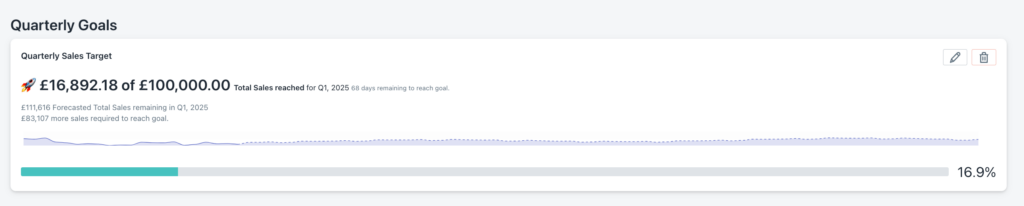
An Example of a Quarterly Goal. Enjoy Setting Monthly, and Quarterly Targets
Reading the forecast line: realized vs unrealized
When you open the Insights page the forecast renders as two lines on the same chart:
- The solid line is realized sales, the orders Shopify has actually booked.
- The dotted line is the forecast for the same window.
The gap between the two is the part of the forecast you have not closed yet. Treat it as your remaining target for the period rather than a passive prediction. If the gap is widening, that is the moment to revisit ad spend, run a promo, or push a re-engagement flow at your loyal segment. If you are tracking ahead of the dotted line, the next decision is usually about inventory rather than marketing.
A forecast is most useful when you treat it as the benchmark to beat, not the number you hope shows up on its own.
Related guides
More on this topic from the By the Numbers team:
- Best SKU Practices for Shopify Inventory Management
- How to Group SKU for Shopify Inventory Management
- Shopify Sales Velocity: What It Is and Why It Matters for Growth
- Shopify Sales Trends Insights That Help You Move Faster
- How Seasons Affect Shopify Sales: Smarter Inventory and Sales Planning
- Shopify Inventory Forecasting Tips That Increase Your Sales
- Early Sales Drop Warning Signs Shopify Owners Shouldn’t Ignore
- how to use data spot early bestsellers shopify
By the Numbers builds this into the dashboard. See sales forecasting.
Empower your Shopify business with data
Turn your store data into actionable insights. Join hundreds of Shopify merchants making smarter decisions.
- AI-powered analytics
- Customer segmentation
- Predictive forecasting
- One-click Shopify install